In mainland China, a bank card that has been restricted from non-counter transactions usually got there by one of two routes. One is a control the bank itself applies to an abnormal account under the Anti-Telecom and Online Fraud Law. The other is a financial punishment the bank carries out after a public security authority has listed someone under the Measures for Joint Punishment of Telecom and Online Fraud and Related Violations and Crimes. The legal basis, the duration and the body you appeal to are different for each.
For the second route, several points are fixed in the text. Before the measures take effect, the public security authority that made the determination has to notify you in writing. The term is two or three years; repeated punishments run cumulatively, though for no more than five years in a row; and the measures lift automatically when the term ends. If you object, you appeal to the public security authority that made the determination. Each route has its own channel, so the first job is to find out which one applies to you. Anyone who says they can get the restriction lifted for a fee isn't part of either channel.
These are mainland China's rules, and they concern accounts held with banks and payment institutions there. The official texts linked at the end are in Chinese, and the English names of the laws used on this page are translations of their Chinese titles.
What still works once non-counter outgoing payments are restricted?
The most urgent part first. If yours is a joint punishment, Article 6 of the Joint Punishment Measures sets three measures for banks and payment institutions:
| What it targets | How the article restricts it | Exception the article leaves |
|---|---|---|
| Bank accounts and digital yuan wallets in your name | Non-counter outgoing payments are restricted | Payments for basic living needs, such as taxes, social insurance, water, electricity and gas, that are collected by withholding or direct debit under an existing agreement with the institution holding the account |
| Payment accounts in your name | Payment account services are stopped | Transferring the balance to a bank account in your own name |
| New accounts | Opening new payment accounts and real-name digital yuan wallets is suspended | None; the article adds that newly opened bank accounts are also restricted from non-counter outgoing payments under item (1) |
The punishment also includes the telecom and network measures in Article 7. Within ten working days of receiving the punishment notice, you can apply to keep one phone SIM card in your name that isn't involved in the case.
Three terms in that table need reading precisely. The restriction is on outgoing payments: the Measures don't say the money in the account is taken or frozen. If a stop-payment order or a freeze has been applied at the same time, that is a separate matter, dealt with further down. The restriction is also on non-counter channels, which generally means the ones not handled by a teller: mobile banking, online banking, ATMs, POS card payments, and quick-pay linked to third-party payment apps. The article doesn't say how counter business is limited, but what the counter will do for you and which documents to bring are for the bank that holds the account to answer. And the exception covers only basic living payments under an existing agreement, not every automatic debit. Whether a particular debit falls inside it is a question to take to that bank, with the agreement in hand.
If the restriction is the bank's own control, there is no such table to check against. Article 18 of the Anti-Telecom and Online Fraud Law gives banks a list of options (verifying the transaction, re-verifying identity, delaying payment and settlement, restricting or suspending the relevant services) and leaves the bank to choose according to the risk. How far the restriction goes is something only your bank can tell you.
Bank risk control or police-determined joint punishment: the two routes
On your phone the two can look identical. The difference lies in who made the decision and under which article.
Route one: the bank's controls on abnormal accounts
Article 18 of the Anti-Telecom and Online Fraud Law requires banks and payment institutions to set up monitoring for abnormal accounts and suspicious transactions and, for the ones that monitoring identifies, to take the necessary preventive measures according to the risk: verifying the transaction, re-verifying identity, delaying payment and settlement, restricting or suspending the relevant services. The bank is the one that acts. The article doesn't require a public security authority to make a determination first, and it sets no time limit on these measures.
Route two: joint punishment after a public security determination
Article 31 of the same law prohibits illegally buying, selling, renting out or lending bank accounts, payment accounts, phone SIM cards and the like; helping others get through real-name verification; and opening accounts under someone else's identity or a made-up agency relationship. For people whom a public security authority at or above the level of a city divided into districts (shortened below to a city-level public security authority or above) has determined to have done these things, and for people who have received a criminal penalty for telecom fraud or related crimes, the law allows an entry on their credit record and measures such as restricting account functions and stopping non-counter services, with a right to appeal. Article 1 of the Measures states that they are made under this law, among others. The Measures were issued as Order No. 170 of the Ministry of Public Security, the National Development and Reform Commission, the Ministry of Industry and Information Technology and the People's Bank of China, and Article 18 sets December 1, 2024 as the date they took effect.
Article 3 of the Measures sorts the people subject to punishment into two groups. The first is people who have received a criminal penalty for telecom and online fraud, or for related crimes such as assisting information network criminal activity, obstructing credit card administration, infringing citizens' personal information, or concealing or disguising criminal proceeds. The second group doesn't depend on a conviction. It covers people determined by a city-level public security authority or above to have illegally bought, sold, rented out or lent three or more bank accounts, payment accounts, phone SIM cards or similar items, or to have done so three or more times, or to three or more recipients, or to have helped with real-name verification for them (under Article 17, a threshold stated as a number or more includes that number). It also covers people who opened such cards and accounts under another person's identity or a made-up agency relationship.
One sentence after the numerical thresholds is easy to miss. Where one of the first three situations falls short of the threshold but has caused a relatively large impact and punishment is genuinely necessary, the person can still be listed once a public security authority at or above the provincial level has reviewed and determined it. So don't reckon that lending one card, one time, leaves you in the clear.
| Bank's abnormal-account controls | Joint punishment after a public security determination | |
|---|---|---|
| Basis | Article 18 of the Anti-Telecom and Online Fraud Law | Article 31 of the Anti-Telecom and Online Fraud Law; the Joint Punishment Measures |
| Who decides | Banks and payment institutions, according to the risk | A determination by a city-level public security authority or above, or an existing criminal penalty; below the numerical threshold, review and determination by a public security authority at or above the provincial level |
| Notice | Article 32 of the law: the reason for the measure, the channels for relief and the documents to submit must be communicated | Article 13 of the Measures: written notice before the measures are carried out |
| Duration | Not set in the text | Two or three years; repeated punishments run cumulatively, for no more than five years in a row; lifted automatically at expiry |
| Who to appeal to | The department or entity that made the decision or took the measure | The public security authority that made the determination |
Which one is yours? Check for a written notice, then ask your bank
Start by thinking back. Article 13 of the Measures requires the public security authority that made the determination to notify the person in writing, in person or by post or similar means, before the relevant departments carry out the measures. The notice covers the grounds and basis for the punishment, its term, the measures, and the right and channels to appeal. Article 12 gives banks and payment institutions ten working days from receiving the punishment information to carry it out. By the text, written notice comes first and the restriction follows.
If you signed for or received a document like that, the route is largely settled, and the term and the appeal channel are written on it. If you're sure you didn't, hold off on a conclusion: the postal address on file may be an old one. That is when the second step matters.
Then go and ask. Take your ID to the counter of the bank that holds the account, or call the bank's official customer service line, and put one question: is the non-counter restriction on this card the bank's own risk-control measure, was it applied on the basis of punishment information from a public security authority, or did some other department require it? All you need from this step is the category.
If the answer is that it's the bank's own measure, go on to ask for the reason, the channels for relief and the documents you need to submit. You aren't asking a favor. Article 32, paragraph 3 of the Anti-Telecom and Online Fraud Law provides that where restrictions, suspension of service or similar measures are applied to suspected fraud-related abnormalities under Article 18 and related provisions, the reason for the measure, the channels for relief and the documents to be submitted must be communicated.
If you have lent your card to someone in the past, or received or passed on money for someone else, think that through as well while you work out the route. It bears on how accounts get flagged once tainted funds are traced.
How long does a joint punishment last? Two years, three years and the five-year cap
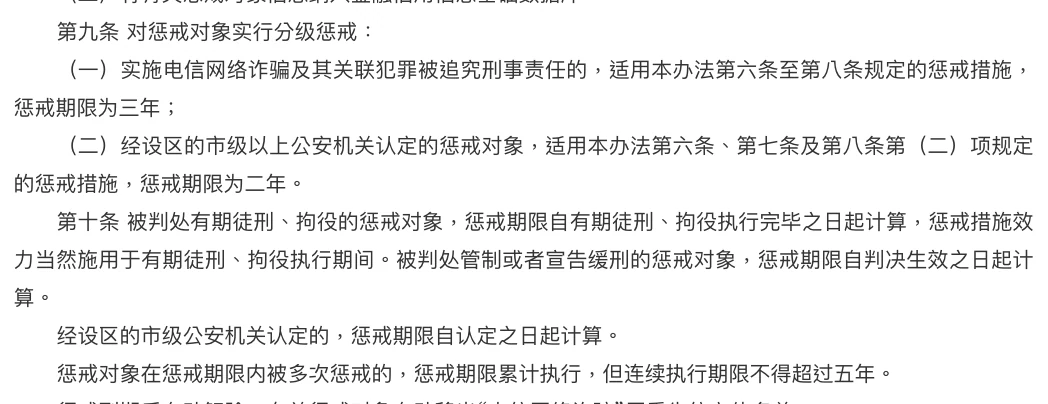
This section applies to joint punishment only. Bank controls have no term in the text, so don't carry these numbers over to them. The cover screenshot shows the two articles below as they appear on the Ministry of Industry and Information Technology's website.
| Situation (Article 9) | Measures that apply | Term | Counted from (Article 10) |
|---|---|---|---|
| Committed telecom and online fraud or a related crime and was held criminally liable | Articles 6 to 8 | Three years | For fixed-term imprisonment or criminal detention, from the day the sentence has been fully served (the measures apply as a matter of course while it is being served); for public surveillance or a suspended sentence, from the day the judgment takes effect |
| Determined by a city-level public security authority or above | Articles 6 and 7, and item (2) of Article 8 | Two years | From the date of the determination |
Note that the two-year tier carries only one credit punishment, item (2) of Article 8: entry in the Financial Credit Information Basic Database. Item (1) puts the person on the list of seriously dishonest entities for telecom and online fraud, shares the listing with the National Credit Information Sharing Platform and publishes it on the Credit China website, and the text assigns it only to the tier for people held criminally liable. The text provides for the entry and nothing more; it doesn't spell out specific effects on loans or card applications.
Paragraphs 3 and 4 of Article 10 answer the question of when it ends. Where a person is punished more than once within a punishment term, the terms run cumulatively, but the continuous period may not exceed five years. When the term ends the punishment lifts automatically, and anyone who was listed is removed automatically from the list of seriously dishonest entities. You don't have to apply when the term ends. If the term has ended and the restriction is still there, you can appeal, as the next section explains. When you come across the claim that every non-counter restriction lasts five years, set it against the text: a single term is either two years or three, and five years is the cap on cumulative, continuous enforcement.
One more point. Article 18 of the Measures provides that they don't apply to acts listed in Article 3 that were committed before the Anti-Telecom and Online Fraud Law took effect on December 1, 2022. That means only that these Measures don't apply. It doesn't mean those acts carry no liability under other laws.
Who do you appeal to, and what deadlines does the text set?
Joint punishment: the public security authority that made the determination
Article 14 of the Measures lists two situations in which you can appeal: you object to the punishment determination, or the measures haven't been lifted after the term ended. You can do it in person, by phone or in writing, and it goes to the public security authority that made the determination, not to your bank. The written notice names that authority. The text sets this timetable for it:
- within three working days of receiving the appeal, tell you in one go which materials to provide;
- within fifteen working days of receiving the materials, complete the review and give you the result in writing;
- if the punishment isn't lifted, give the reasons.
Where the review finds the determination was indeed wrong, a release notice is issued and reported up level by level under Article 15, and Article 16 requires banks, payment institutions and the other bodies involved to lift the measures within ten working days of receiving it. Article 15 also states that where a wrong determination has caused harm, those responsible are to be held to account according to law.
My advice is plain. Keep the original notice and photograph it as a backup. Appeal in writing where you can, and keep a record of what you handed in. Prepare exactly the materials you're told to. Where criminal questions are involved, how to state the facts is something to take to a practicing lawyer.
Bank controls: go back to your bank and use the channel it tells you
Article 32, paragraph 3 of the Anti-Telecom and Online Fraud Law lets the person affected appeal to the department or entity that made the decision or took the measure. That body has to accept the appeal promptly and review it, and where the review is passed, lift the measure immediately. In practice, go back to your bank first and get the reason, the channel and the list of documents. If the bank made the decision itself, submit through the channel it gives you. If another department decided and the bank is only carrying it out, the appeal goes to that department. Explain truthfully whatever you're asked to explain, and where the transactions were genuine, produce the genuine records. The text requires only prompt acceptance and immediate lifting; it doesn't set a number of days for the review.
A non-counter restriction is not a stop-payment order or a freeze
A non-counter restriction often gets described loosely as a frozen card. The measures discussed on this page restrict service functions; stop-payment orders and freezes are a different set of measures. Article 20 of the Anti-Telecom and Online Fraud Law says only that the public security department of the State Council, together with other departments, is to establish and improve systems for emergency stop-payment, rapid freezing and timely unfreezing, with public security authorities deciding according to law and banks cooperating. The specific conditions and release procedures aren't in either of the two documents, the Joint Punishment Measures or the Anti-Telecom and Online Fraud Law. If your bank tells you plainly that a stop-payment order or freeze came from a public security or judicial authority somewhere, you're not in the situation this page describes.
In that situation, start by finding the reason the account was frozen, bearing in mind that how long a freeze lasts varies by type. If it's tied to payments received for selling USDT, there are steps to take after the freeze. Treating the two things as one is likely to send you to the wrong office. The idea that taking your ID to the branch and explaining will get the card released matches only some of the cases under route one. Under a joint punishment, the term and the body you appeal to are the ones in Articles 9, 10 and 14 of the Measures.
What not to do while the restriction is in place
- Don't go to anyone who charges to lift restrictions or clear a name from a list. The releases these two documents provide for are automatic lifting at the end of the term, a release notice issued after a public security review finds the determination was wrong, and immediate lifting once a bank's review is passed. Article 31 of the Anti-Telecom and Online Fraud Law also requires the relevant departments to set up credit repair and relief systems. Every one of these runs through official channels, and none needs a middleman or a payment.
- Don't carry on receiving and making payments through a relative's or friend's card or payment account. Lending and renting out bank accounts and payment accounts is prohibited by paragraph 1 of Article 31 of the Anti-Telecom and Online Fraud Law, and Article 44 sets the penalty: confiscation of illegal gains and a fine of one to ten times those gains, or a fine of up to 200,000 yuan where there are no illegal gains or they come to less than 20,000 yuan; in serious cases, detention of up to fifteen days as well. If the money turns out to be fraud-related, criminal liability may come into it too: item (1) of Article 3 of the Joint Punishment Measures lists assisting information network criminal activity and concealing or disguising criminal proceeds.
- Don't count on opening a new card at another bank and using it as normal. For a listed person, item (3) of Article 6 of the Measures means newly opened bank accounts are likewise restricted from non-counter outgoing payments. Where it's a bank's own control, moving to another bank and continuing to receive the same kind of payments can get the new card flagged as abnormal as well, and it is easily read as deliberate evasion.
- Don't throw the notice away. The appeal channel is written on the notice or communicated by your bank. After you appeal, it's normal for the public security authority to contact you for more materials, but it won't ask for a verification code or tell you to transfer money. If you're unsure, hang up, look up the official number yourself and call back.
- If the restriction is connected to payments for buying or selling USDT, know the position taken in Yinfa [2026] No. 42 first, the notice on virtual-currency risks listed below. Item (1) states that business activities related to virtual currencies are illegal financial activities, and running an exchange business between legal tender and virtual currencies inside mainland China is on its list. Item (6) requires that financial institutions, non-bank payment institutions included, not provide account opening, fund transfer, clearing or settlement services for business activities related to virtual currencies. Item (19) states that where any organization or individual invests in virtual currencies, real-world asset tokens or related financial products in a way that goes against public order and good morals, the civil acts involved are invalid and the resulting losses are borne by that party, and that conduct suspected of disrupting financial order or endangering financial security is investigated and dealt with by the relevant departments according to law. How this applies to you is not something this site will conclude. For criminal questions, consult a practicing lawyer.
The three documents these provisions come from (texts as of September 2026)
- Measures for Joint Punishment of Telecom and Online Fraud and Related Violations and Crimes: Order No. 170 of the Ministry of Public Security, the National Development and Reform Commission, the Ministry of Industry and Information Technology and the People's Bank of China, in effect from December 1, 2024; published on the Ministry of Industry and Information Technology's website.
- Anti-Telecom and Online Fraud Law of the People's Republic of China: in effect from December 1, 2022; reposted on the Beijing Municipal Public Security Bureau's website.
- Notice on Further Preventing and Dealing with Risks Related to Virtual Currencies (Yinfa [2026] No. 42): issued by the People's Bank of China and seven other departments, published on the People's Bank of China's website on February 6, 2026.
Common questions about non-counter restrictions
Can I still withdraw cash at the counter when my bank card is restricted from non-counter transactions?
It depends on which kind of restriction it is. Article 6 of the Joint Punishment Measures restricts the non-counter outgoing payment function of bank accounts, and the text doesn't say how counter business is limited. Where the bank applied its own control under Article 18 of the Anti-Telecom and Online Fraud Law, the bank decides the measure according to the risk, and there is no uniform scope. What the counter can actually do for you, and which documents to bring, are for the bank that holds the account to answer.
How long does a non-counter restriction last?
For a joint punishment that follows a public security determination, the term is in Articles 9 and 10 of the Joint Punishment Measures: two years for people determined by a city-level public security authority or above, three years for people held criminally liable. Article 10 provides that repeated punishments within a term run cumulatively, for no more than five years in a row, and that the punishment lifts automatically at expiry. For a bank's own abnormal-account control, the text sets no term; all you can do is ask the bank for the reason and the documents it needs.
How do I find out whether I've been listed for joint punishment?
Article 13 of the Joint Punishment Measures requires the public security authority that made the determination to give written notice, in person or by post or similar means, of the grounds and basis, the term, the measures and the appeal channels before the measures are carried out. If you have received a document like that, the route is largely settled. If you haven't, take your ID to the bank that holds the account and ask whether the restriction is the bank's own measure or was applied on the basis of punishment information from a public security authority.
The bank won't lift the non-counter restriction. Who can I appeal to?
There are two cases. Under a joint punishment, if you object to the determination or the measures weren't lifted at expiry, appeal in person, by phone or in writing to the public security authority that made the determination. It has three working days to tell you in one go which materials are needed, and fifteen working days from receiving them to give you the review result in writing. For a control applied by the bank, Article 32, paragraph 3 of the Anti-Telecom and Online Fraud Law requires that you be told the reason, the channels for relief and the documents to submit, and lets you appeal to the department or entity that made the decision or took the measure. So go back to your bank and find out which it is: if the bank decided it, submit through the channel it gives you; if a department decided it and the bank is carrying it out, the appeal goes to that department.
Someone says they can get the restriction lifted or my name taken off the list for a fee. Can I trust that?
No. Under the Joint Punishment Measures and the Anti-Telecom and Online Fraud Law, a restriction ends in one of these ways: automatic lifting when the punishment term expires, a release notice issued after a public security review finds the determination was wrong, or immediate lifting once a bank's review is passed. Article 31 of the Anti-Telecom and Online Fraud Law also requires the relevant departments to set up credit repair and relief systems. All of these run through official channels, and none of them needs a middleman or a payment. Work out the route first, then go to the department or entity that goes with it.