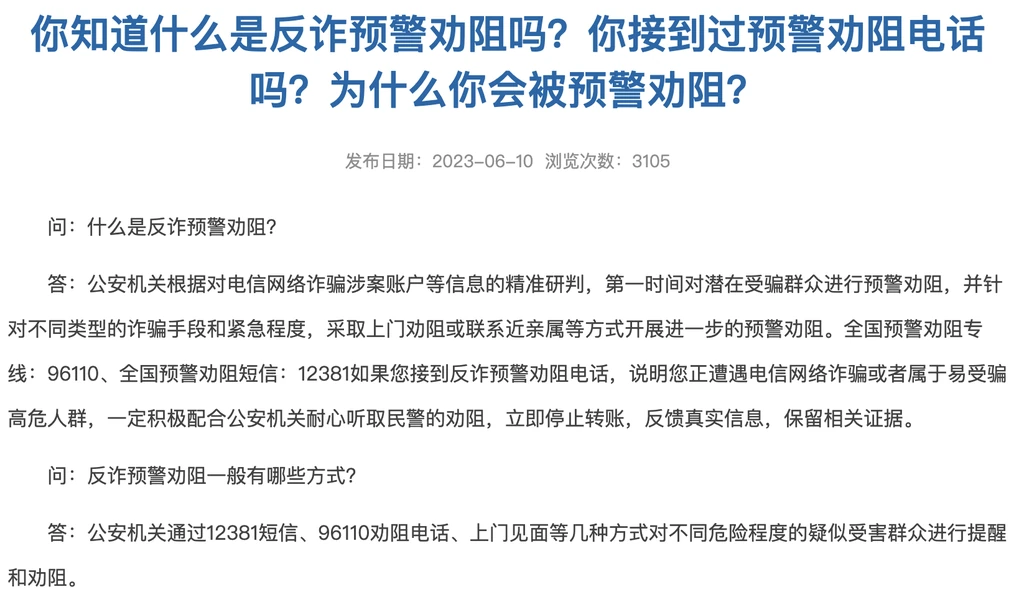
96110 is mainland China's national anti-fraud warning hotline, launched jointly by the Ministry of Public Security and the Ministry of Industry and Information Technology. A call from it means the police believe you may be the target of telecom or online fraud right now, or that you belong to a group at high risk of being scammed. Pick up, let the officer finish, and stop any transfer you're in the middle of, including USDT you were about to send. The numbers and procedures here are mainland China's, and the official pages cited are in Chinese.
Most of what this site covers is cleaning up after a card has been frozen. When the warning call comes, the money may not have left yet, or only part of it has. Stopping during that call means the transfers that would have come next never happen.
What to do once you pick up, in order
Don't hang up on 96110; answer it promptly. That is the public security authorities' own advice, in a Qinghai Daily report republished on the Qinghai Provincial Government's website on 27 March 2024. Once you're on the call, the Q&A page on the Shenzhen Municipal Public Security Bureau's website asks you to cooperate, listen patiently to the officer, stop transferring money at once, give truthful information and keep the relevant evidence. The last column of the table shows which steps come from those official pages and which this site has added.
| When | What to do | Source |
|---|---|---|
| The phone rings | Answer it and stay on the line | Public security advice (republished on the Qinghai government site) |
| During the call | Hear the officer out | Shenzhen police website |
| During the call | Stop transferring money at once | Shenzhen police website |
| During the call | Stop paying for USDT, stop sending USDT to an address someone gave you, stop topping up any platform | This site's reading of "stop transferring money" |
| During the call | Answer questions truthfully | Shenzhen police website |
| After you hang up | Keep the chat logs, transfer records, and any address or app the other side gave you | Keeping evidence is an official requirement; the list is this site's |
| The caller asks you to transfer money, install software or share your screen | Hang up and call 96110 yourself straight away to check | This site's advice |
| Officers come to your door | Check who they are, then cooperate | Shenzhen police website |
Plenty of people hang up on unknown numbers out of habit, or cut the call after a few seconds thinking it's a sales pitch. Hanging up on this one doesn't close the matter. If you refuse the call, or can't be reached by text, by 96110 or on WeChat, officers will come to your door, according to the Shenzhen page.
While you listen, don't rush to insist you haven't been scammed. The officer has information you can't see, and may not know your side of the story either. Let them finish, so both sides of the story can be pieced together.
For someone who buys and sells USDT, "stop transferring money" covers more than bank transfers. It includes a C2C order you've placed but not yet paid for, USDT you were about to withdraw from an exchange to an address someone gave you, and money you meant to deposit on an "investment platform". If the other side comes up with a reason why you should send just one more payment, stop that one too.
Giving truthful information means answering whatever the officer asks: who told you to buy USDT, who you've sent money to, how much and where, and which apps the other side had you install. Even if you think you were trading normally, say so plainly and let the officer judge.
Keep the evidence after you hang up
Once the call ends and panic sets in, it's tempting to delete the chats and uninstall the apps, as if cutting everything off would make you safe. That gets it backwards. When officers visit, they ask the person being warned to hand over the chat logs with the fraudsters and to show the suspected scam software they used (Shenzhen police Q&A). Anything deleted or uninstalled can't be shown.
If you trade USDT, the records that matter are spread across several places:
- Chat logs: private messages with the other person and any group you were pulled into. Screenshot whole conversations and leave the originals on your phone untouched.
- Transfer records: bank statements, C2C orders, and the transaction hash of any USDT you've already sent.
- What the other side gave you: receiving addresses, platform URLs, apps or installation files you were asked to download.
- Their identity details: account names, nicknames, phone numbers. Write them down even if they look fake.
This site put the list together for people who trade USDT. Which materials are actually needed is for the police to say.
Why 96110 and 12381 get in touch with you
Based on targeted analysis of accounts and other information linked to telecom and online fraud cases, the police issue warnings to potential victims as early as possible. Depending on the type of scam and how urgent it is, they may follow up by visiting in person or contacting close relatives (Shenzhen police Q&A, published 10 June 2023).
Warnings come as a 12381 text message, a 96110 call, a visit in person and so on, graded by how much danger the possible victim is in. 12381 is the national warning text service. Like the 96110 call, it is one of the police's warning channels, so a text from it is the police alerting you as well.
The Qinghai report spells out a little more of what the call means: you or a member of your family is being targeted by telecom or online fraud, or you belong to a group at high risk of being scammed. Even if you're sure you haven't touched anything suspicious, don't just hang up. Ask whether an older relative has been doing any online "wealth management" lately, or has been told to go and buy something.
Keep warnings and card freezes apart. A warning is aimed at people the police see as potential victims. A freeze is what happens after an account has been found to involve fraud proceeds, and it follows a separate procedure. A warning call doesn't mean your card is frozen, and it doesn't mean you're being treated as a suspect.
If your card has already stopped working, find the cause in Bank account suddenly frozen? What to do first. If the card you use to receive payment for USDT has been frozen, start with Bank account frozen after selling USDT: what to do.
If you buy USDT, watch the step where it leaves your account
For the scam types that involve heavier manipulation, the Shenzhen page gives impersonation of police, prosecutors or courts, "pig-butchering" scams and investment or wealth-management scams as examples. A common step in the last two is getting you to buy USDT first and then send it to an address they provide, or deposit it on some platform. That makes a USDT trader who gets a warning call more likely to be caught up in one of those two. Changing yuan into USDT looks ordinary; the money only truly passes to someone else at the moment the USDT leaves your account.
| Whose idea was it to buy USDT? | Where does the USDT go? | When 96110 calls |
|---|---|---|
| Someone you met online, a "teacher" in a chat group | To an address they gave you | Stop immediately and keep both the address and the chats |
| An investment platform | Deposited on that platform | Stop depositing; keep the platform's URL and app |
| Yours | Kept in your own account for your own use | Answer anyway, and explain where you bought it and what it's for |
When you size up your situation, look at where the USDT goes after you buy it, and who decides that. Choosing to keep it in your own account is a completely different position from having someone send you an address and press you to transfer. In the second case, stop as soon as this call comes, and drop the idea of "just this last one".
If you simply buy and sell USDT for yourself, you still answer the call and hear it through, and say plainly who you traded with, what you bought it for and whether you passed it on to anyone. Whether this has any consequences for you later isn't covered on the official pages, and I can't give you an answer on that.
Officers may visit if they can't reach you by phone
Officers come in person in these situations: you refuse the call, or can't be reached by text, 96110 or WeChat; or the scam is one of the types with heavier manipulation, such as impersonating police, prosecutors or courts, pig-butchering or investment and wealth-management scams, and calls and texts haven't worked. Then officers visit or find you to check face to face (Shenzhen police Q&A).
If someone knocks and says they've come about an anti-fraud warning, the official guidance is to verify the officer's identity first and then cooperate. If it were me, I'd look up the local police station's number myself and ring to ask, rather than use a number the visitor hands over.
Once their identity checks out, answer truthfully, bring out the chat logs you kept, and open any suspected scam app you were told to install so the officer can see it. This is why the earlier advice says not to delete chats or uninstall apps.
When in doubt, call 96110 yourself
Besides placing warning calls, 96110 takes enquiries and reports. If you run into a suspected scam you can call 96110 to ask about it, and if you come across leads on fraud-related crime you can report them on the same line (Qinghai Daily report republished on the Qinghai Provincial Government's website).
That gives you a way to check. A warning call asks you to stop transferring money. A caller claiming to be 96110 who instead tells you to download software, share your screen, or send money or USDT somewhere doesn't match that description. Hang up, call 96110 yourself straight away, and don't ring back any other number the caller gave you. If the caller asks for none of that, hear the officer out first.
Reports go through the same line. If you know a group or platform is pulling people in with the "buy USDT, then send it to this address" script, you can call 96110 and pass the lead on.
The next time someone tells you to buy USDT and send it to an address they give you, call 96110 before you transfer and repeat to the person who answers exactly what you were told.
Questions about 96110 and 12381
I missed a call from 96110. What should I do?
You can call 96110 yourself and go through your recent transfers and USDT purchases. When someone can't be reached by text, 96110 or WeChat, officers come to the door, so don't treat a missed call as nothing.
Does a 12381 text matter?
12381 is the national warning text service and, like the 96110 call, one of the police's warning channels. Don't delete it as spam. Once it arrives, stop transferring money and keep the evidence, the same as for a call.
Will 96110 ask me to transfer money?
A warning call asks you to stop transferring money, and moving money is not among the 96110 functions the official sources list. If someone on the line asks you to transfer money, download software or share your screen, treat it as suspicious, hang up and call 96110 yourself to check.
Does a warning call mean I'm treated as a suspect?
Warnings go to people the police see as potential victims. Getting one means you are being targeted by telecom or online fraud, or belong to a group at high risk of being scammed (Shenzhen police website). A frozen account is handled under a different procedure; keep the two apart.